

A short health video can contain more information than its running time suggests. A speaker names a protein, a graphic changes its units, and a caption introduces a qualification that is never spoken aloud. Someone reading the transcript should be able to follow those details without repeatedly restarting the player.
A useful transcript is therefore more than an automatic speech export. It is a readable record of the explanation, with clear speakers, accurate terminology, and the visual information needed to understand the argument. The following method works for interviews, narrated explainers, and short research-news clips.
Decide what the reader needs from the transcript
The W3C guidance on media transcripts distinguishes a basic transcript of speech and relevant sound from a descriptive transcript that also communicates necessary visual information. That distinction matters when a video relies on charts, demonstrations, or words displayed on screen.
Start by watching the clip once with the picture hidden and once with the sound muted. These are editorial checks, not accessibility certifications. In the first pass, note what becomes confusing without the graphics. In the second, identify messages that appear only in captions or diagrams. Together, the notes reveal information that a speech-only transcript would omit.
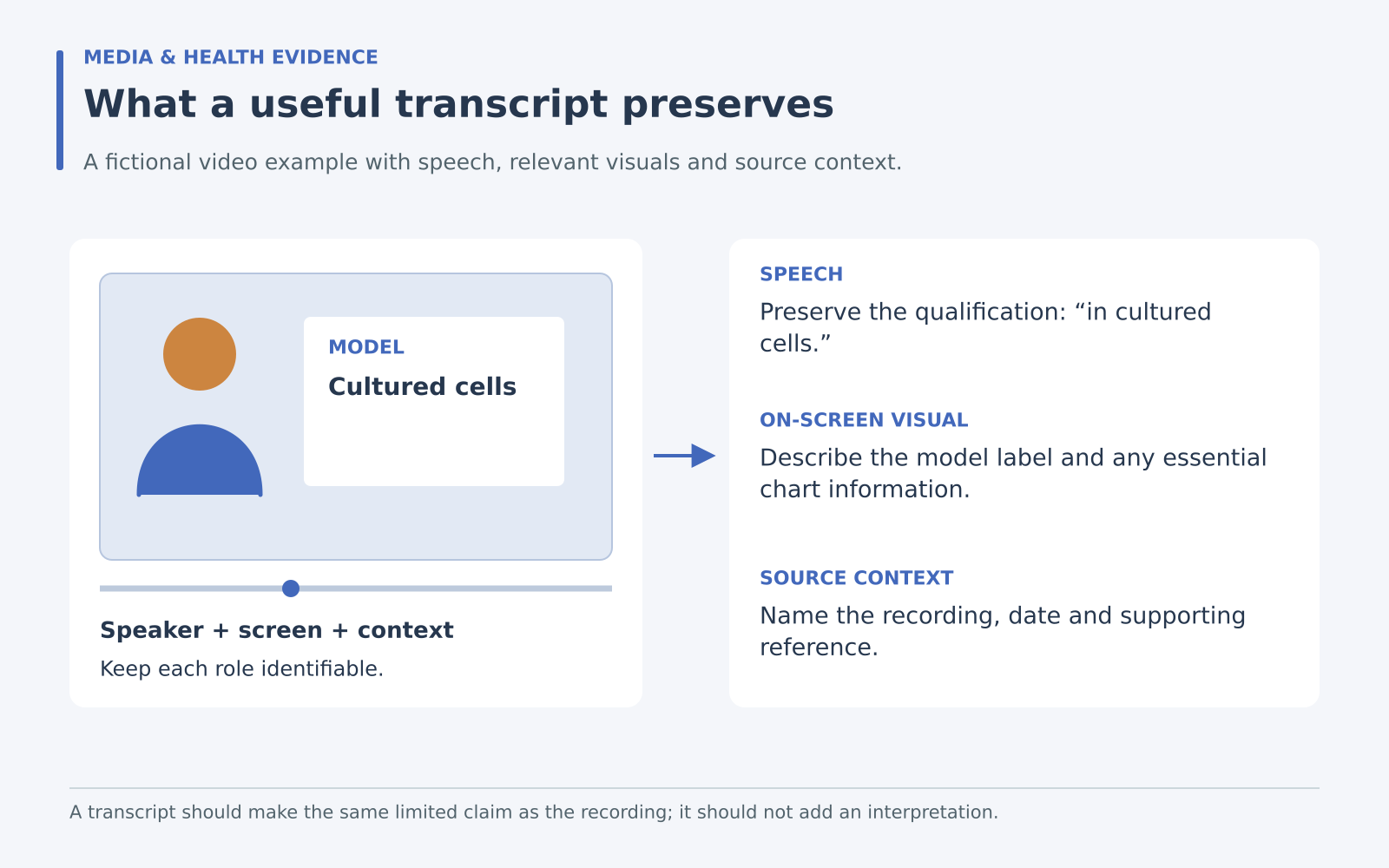
A decorative shot of a laboratory corridor may need no description. A graphic changing from “cells” to “human participants” needs careful attention because the setting has changed. Describe the information that helps the reader understand the explanation, rather than cataloguing every camera movement.
Give people and terminology stable names
Identify each speaker consistently. “Presenter” and “Researcher” may be sufficient when the identities are already stated above the video. If you include a name or qualification, verify it against the actual recording and supplied credits. Do not convert a guest’s job title into a medical credential.
Build a small terminology list before correcting the automatic transcript. Include compound names, abbreviations, institutions, and units. A peptide name can look unfamiliar to a transcription system, while an abbreviation may resemble an everyday word. Check the audio and the relevant slide together; neither source automatically overrides the other if they disagree.
On first use, write an abbreviation in the form used by the speaker and provide an expansion only when it is verified. Keep later uses consistent. Changing between several spellings of the same molecule makes search, quotation, and further checking unnecessarily difficult.
Preserve the words that limit a claim
Small words often carry the scientific meaning. “May,” “associated with,” “in this experiment,” and “not statistically distinguishable” should not disappear during cleanup. Removing repeated filler is different from strengthening the statement.
Consider this fictional line: “In the cell experiment, the marker increased, but we have not tested the same question in people.” A polished transcript must retain both the cell setting and the untested human question. Editing it to “The treatment increased the marker” changes the object, the setting, and the apparent certainty.
If a speaker corrects a number, retain the corrected value and make the correction understandable. If the number cannot be resolved, flag the uncertainty in an editorial note instead of selecting whichever value looks more plausible. The transcript should make checking easier, not quietly replace the original evidence.
Describe a chart without inventing its interpretation
A chart description needs its subject, axes, groups, units, and the particular comparison discussed. It does not always need every plotted point. For a short clip, a compact table can communicate values more clearly than a long description of bar heights.
Suppose a fictional graphic compares two groups on a laboratory measurement. A useful entry might identify “Group A and Group B, measurement in arbitrary units, assessed after seven days.” If the graphic supplies no sample size, the transcript should not supply one. If the narrator gives a causal explanation that the graph itself cannot establish, preserve that explanation as the narrator’s statement.
Separate descriptions from speech using a consistent label such as “On-screen chart.” This prevents a reader from attributing the editor’s description to the interviewee. It also makes future corrections easier because the two kinds of text have distinct jobs.
Use structure that supports a quick return visit
Most readers will not study the transcript from beginning to end. Some want the spelling of a molecule; others want the study date or the limitation mentioned near the end. Organize the text around those tasks.
- Use short paragraphs when the speaker changes subject.
- Add descriptive headings at genuine topic changes.
- Use occasional timestamps to help readers locate a section.
- Keep a list or table when the video presents parallel items.
- Place source identification close to the relevant statement.
A timestamp on every few words makes prose difficult to scan. A timestamp at the beginning of a meaningful section usually provides a better balance. Keep the transcript selectable and searchable, rather than publishing it only as an image.
Make the origin and date easy to find
The MedlinePlus guide to evaluating health information encourages readers to examine who provides information, why it was published, and how it is supported. A transcript can make those questions easier to answer by retaining the video’s source, publication date, and relevant study details.
Do not make an old interview appear newly recorded because you have just added its transcript. Distinguish the recording or publication date from the date the text was corrected. If a scientific statement has become outdated, a clearly dated note is more transparent than silently rewriting what the speaker said.
Keep a correction record for changes that alter meaning: a compound name, a unit, a study population, or a numerical result. Minor punctuation adjustments do not need an elaborate history. Readers mainly need to understand whether the substance changed.
Run a final comparison with the recording
For the last pass, play the video while following the finished text. Check names and numbers separately from ordinary prose. Then ask someone unfamiliar with the topic to read one chart-heavy section and explain what was compared.
If the reader can identify the question, the setting, and the qualification without seeing the video, the transcript is doing useful work. It gives the health explanation a second form that can be searched, revisited, and assessed at the reader’s own pace.